Move faster with less to explain and results you can use.

We simplify your work for your agent, so it can do it as well.

Paste into the agent you have open Set up Syns for this project: https://syns-setup.pages.dev/SKILL.md click to copy
agent — zsh
Your agent· deck for Tuesdaysyns-gtm · syns.dev
Ask anything about this project…
Reading your projectlooking for what this needs
  • Claude Community Meetup · Amsterdam · Tuesday, talks 18:40calendar · Claude Community Meetup for Developers
  • The talk notes: eight beats, demo-led, one wiki on screenslides/2026-09-15-claude-meetup/TALK.md
  • The organiser's steer: practical and demo-heavy, no theoryTALK.md § The event
  • Your deck rules, and the two previous decksslides/CLAUDE.md · slides/2026-09-03-ai-tinkerers
  • The wiki on screen: research-atlas, 403 pages, written by agentsresearch-atlas/index.md
Plan. Eleven slides, one per beat. Demos take half the time, so the slides carry only what the demos cannot.
One decisionyour call
Open with the numbers, or with why markdown?
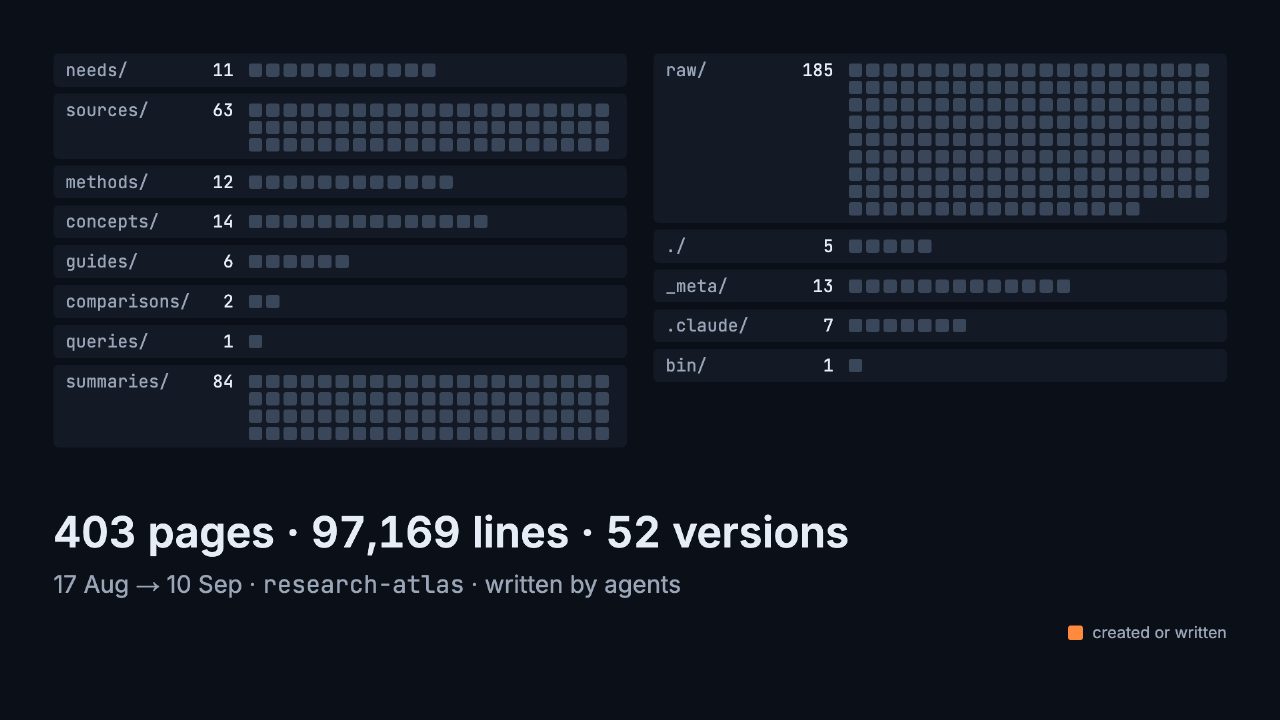
Slide: 403 pages, 97,169 lines, 52 versions
The numbers firstThe organiser asked for demos. The numbers are the demo.recommended
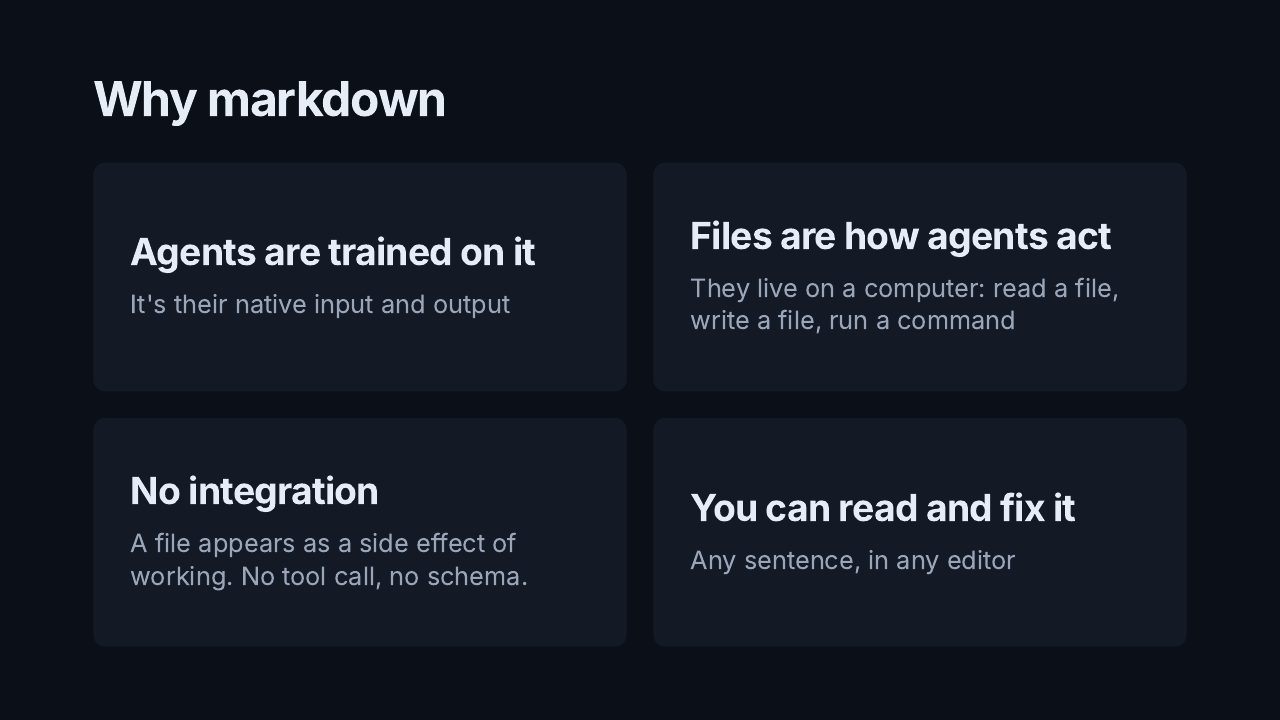
Slide: Why markdown
Why markdown firstThe order the last deck used.
Anything else…
Building the deck0 of 11
Done25 min on its own · 11 min with you
  • 1The deck, eleven slides, dark, keyboard controls — open
  • 2Talk notes in your voice, one card per beat — open
  • 3TALK.md: run of show updated, pushed to syns.dev
Changed since the last deck: the numbers slide moved to second. Nothing else.
What changed

The same agent. The same task. Your project already in its context.

−70%
Time with the agent
6 → 1
Decisions you had to make
5of 5
Clarity of what it is doing
0
Rework rounds
Across your work

The same shape, whatever the task.

Engineering

Build the data collection feature

Without
Add a data collection layer. Monitor all buttons. Ask for confirmation. Plan first. Run the performance tests. CI green.
  1. Reads 40 files to guess the scope
  2. Five questions: provider, which buttons, event schema, consent, which CI
  3. Works; you check the diff three times
  4. CI green. A second event schema, a global click listener, consent changed silently
With Syns
Build the data collection feature.
  1. Reads the roadmap item, the spec, the constraints, the delivery process
  2. One question: all interactive elements through the event bus, or CTAs only? Recommends the bus
  3. Forty minutes on its own; tests green
  4. Change summary, spec updated, decision recorded, the constraint it respected one click away
Decisions 5 → 1Time with the agent −60%Clarity 5 of 5Rework 0
Teamwork

A teammate's agent continues the work

Without
Continue what Ana started yesterday on the export feature.
  1. Nothing on this machine says what Ana decided
  2. A handoff call, a pasted summary, a chat scroll
  3. Her agent's plan is re-derived from the diff, differently
  4. Two agents, two versions of the same intent
With Syns
Continue the export feature.
  1. Pulls Ana's plan and her decisions as they were pushed last night
  2. One question: her open point, with her two options and a recommendation
  3. Continues from her last step, on another machine, no meeting
  4. Pushes; a stale push after hers is rejected rather than overwriting her work
Handoff 0 minRe-explaining noneVersions of the intent 1
Compare

Just a prompt, a skill, or your project's own reasoning.

Just a promptWith a skillWith Syns
Time with the agent38min27min11min
Decisions you had to make641
Clarity of what it is doing1 of 53 of 55 of 5
Result you can use210
Questions

What it is, underneath.

What does Syns actually store?

The reasoning that produces the work: plans, specifications, decisions, constraints, instructions, retrospectives. Markdown files, versioned, in a repository of their own. Not your source code, which stays where it is. Not prompts or transcripts, which are how an agent got somewhere rather than what it decided.

Every agent session pulls before its first turn and pushes at the end, so the reasoning is current on every machine and in every sandbox without anyone running a sync step. That is the whole mechanism, and it is why nothing about your workflow changes.

Why not just commit it to the repo?

You can, until the work-in-progress problem. An agent writes a document over twenty turns. Commit every turn and you have polluted the code history; commit once and you have lost the progression. There is no good commit granularity for a document a machine is thinking through.

And the reasoning changes at a different rate from the code: a plan is rewritten twenty times while the code it describes changes once. It wants its own history, its own versions, and no ceremony between the agent wrote it and the team can see it.

Isn't this just a memory server for agents?

Related, different object. A memory server holds what an agent decided to remember. Syns holds what someone deliberately wrote down and expects to review, diff, and hand to a person. One is how an agent remembers; the other is how a team keeps something. Teams run both.

We'd just use a shared drive, a wiki, or a tool the agent reaches over MCP.

Those work well for humans reading documents. The friction is on the agent side: it needs an integration to reach the content, the round-trip is lossy, and a tool it has to remember to call is a tool it sometimes does not call. A file on disk is always in context because the harness loads it.

These artifacts are read by agents far more often than by people, so the store has to be the thing an agent already knows how to use: files, next to the work, current everywhere.

I'm not giving a third-party tool access to my private code.

Syns holds plans and markdown, not source code. It is a separate repository. It cannot see your code and cannot tell whether a private code repository of yours exists. You can also start a repository inside Syns rather than import anything.

Why hasn't a code host or a frontier lab shipped this?

They have, each for its own agent. That is the gap: a team running two harnesses side by side is served by neither, and a vendor billing per token has no interest in a layer that reduces reads. The heaviest agent users mix vendors deliberately, and they will not keep their decision layer with one of the parties they want to switch between.

Syns is vendor-neutral and tool-agnostic. It sits underneath the workflow tools, not in front of them, and every new tool that produces reasoning as markdown makes it more useful.

Where does the speed come from, technically?

Three places. The prompt gets shorter, because the project's reasoning carries the context you would otherwise re-explain. The questions get fewer and better, because the agent reads what was decided before it decides anything. And the result needs less rework, because the constraints it has to respect are in its context rather than in your head.

The same reasoning is shared by every agent on the team, so the second dispatcher gets the same start as the first.

What is the difference between a skill and Syns?

A skill gives your agent a method. Syns gives it your project: what was decided, what was ruled out, and what the last runs produced. Method is generic. Your reasoning is not, and it is what the agent needs to start informed, ask once, and write back what it decided.

Do I need this on my own?

One person, one agent, one machine: your instruction file and a git repository do all of this. Keep them. Syns starts mattering at the second reader, or the second session that needs to know what the first one decided.

Free for personal use, no credit card, no trial clock. Sign in with GitHub, Google or GitLab. Any agent that can fetch a URL can run the setup line.

What is the interface the agent uses in the demo?

A page the agent wrote for that step. Any agent that can write a file can write one, and several harnesses render them. It is not a Syns screen: the same run in a terminal reads the same files and reaches the same result; the page is how it keeps you informed and asks its one question.

Where do the numbers come from?

From the run shown above, one task in both conditions, counted the same way on both sides: minutes with the agent, decisions it asked you to make, moments you could say what it was doing, rework rounds to a result you accepted. They describe that run; the measured comparison across tasks is still to come, and these figures are replaced by it when it does.

What does not change?

Your agent, your editor, your tracker, your code host. Keep the instruction file you already have. Syns installs from one line, runs in the background, and rolls in as slowly as you like. A push that lands after a teammate's is rejected rather than silently overwriting their work; agents read each other's pushed work and adjust.